
Component Photos of the "Tidal Annisquam" Panoramic Photo
Component Photos of the "Tidal Annisquam" Panoramic Photo
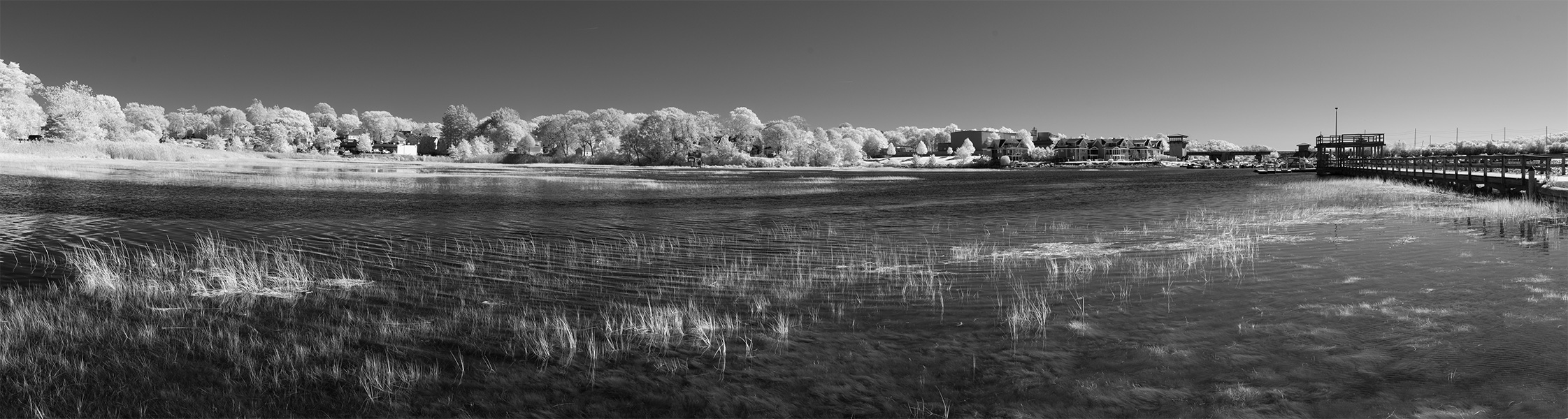
Tidal Annisquam
I shoot a lot of panoramas. The photos above are examples of where a particular panorama (posted to my Blog on 21 August 2026) started, and where it ended up. As you can see, it began as four individual photos that were then combined into a seamless whole in the computer during post processing. The process is known as "stitching" because the photos are "stitched" together. I do this with specialist software. Sounds simple, doesn't it? And it can be simple. This panorama just stitched up on the first run. But sometimes — especially when the picture contains things that move between one photo and the next, like people, or vegetation blowing in the wind — it can take a lot of fiddly and determined editing to make it come together. (And it doesn't always work...) I have a couple of large active urban landscapes that took months... I was still very close to the bottom of the learning curve then, and it was obvious that the final products would be worth it.
On the software, for some years I used an open source product called Hugin. These days I use an app called
PTGui, and I'm very happy with it. Occasionally over the last few years I've had complex projects that PTGui couldn't handle, and I used an extremely powerful product called Autopano Giga. I think updates in PTGui have improved the already excellent program to the point I don't need a backup, which is good, since Autopano has been discontinued and is no longer actively supported, though it's still in my applications folder if needed. Mind, it is my understanding that at least the first couple of programs are based on the 1990s work of a German, mathematician, Professor Helmut Dersch, who published a suite of command line tools named Panotools. Brilliant work all around.
One can stitch together a single horizontal line of photos, or a single horizontal stack of photos, but the software will also stitch two dimensional arrays, a second line of photos above the first line, for example. Or more... I have seen giant panoramas with incredible detail (gazillians of pixels!) made up of hundreds of invidual frames. Of Shanghai from a tall tower, for example. Technical photography at a level far beyond my need!
Of course, panoramas predate digital photography, and photography itself. Interestingly, we have a reproduction of this engraved panorama of London made in 1616 by Claes Janszoon Visscher hanging on our living room wall:

Julee bought it in Stratford-on-Avon when she was on her year abroad in the UK during her college days. If you know where to look, Shakespeare's Globe Theatre is visible in the vista. These sorts of panoramic images weren't uncommon or difficult in the era when creating an image consisted of making marks on a surface by hand. (Disregarding the years of training and practice needed to learn all the basic skills of a draughtsperson or painter, of course!) I find it interesting that one of the inventors of photography (and the person who introduced it to the world) Louis-Jacques-Mandé Daguerre had been apprenticed to a panorama painter when learning his first arts. There is a nice short intro to panoramic imagery on this Wikipedia Page.
Panoramic photography: Well, that was hard. There were limits to how wide a wide angle lens could be, and even as optics improved through the 19th and 20th Centuries, truly wide angle lens were rare and costly. (And remain so, even if not as much.) The solution was to build specialised cameras that moved, one way or another, exposing a bit of the film as they moved. The classic, patented in 1904, was the Circut, in production for nearly fifty years and responsible for so many large group photos during the 20th Century. Others followed. In my second wind as a photographer in my twenties I lusted after the Hulcherama, where the whole camera swung, and the Widelux, where the lens swung, wiping the image onto a curved film plane. I did, more recently, own a Russian Horizont camera, identical in concept to the Widelux, but didn't use it much. Even putting aside the issues of film in the digital age, I had already been shooting digital panoramas for some time and found that with all the technical issues of the digital process, it was still — for me — an easier and much more flexible approach than film. Of course, now, most cell phone camera programs have a panning-to-panorama feature. I don't use it, first, perhaps, because when this process became available I was already make panoramas by hand from my big camera images, and was happy with the process and results. And I'm still happy with them!